
The Post-Trump Climate Debate
A couple of weeks ago, I got some extra writing time because it was simply too hot to go outside. The state was under a heat dome, with temperatures just shy of one hundred degrees. My town has a total exterior water ban so I watched my grass burn and the plants I had cultivated for years wilt in the sun. Even my bees, who prefer their hive at a comfortable 95 degrees, were struggling to stay hydrated and cool.
Donald Trump may call climate change a hoax, and many Republicans may go along with him in public, but polling shows that most Americans, Republican, independent, and Democrat, are smarter than that. The majority does not need to understand the science of global warming in order to observe it in their daily lives: more frequent and severe natural disasters, record heat, flooding, wildfires, and rising insurance premiums. Extreme weather events have already cost the country $600 billion this decade.
I have little doubt that once Trump exits and the party reconsiders its future, the discussion will shift from “is it true” to “what should be done.” And this is where it will get complicated. Will we be able to have a rational discussion of the challenge, or will the same polarization that has plagued many of our public policy discussions prevail? More specifically, will the political parties be guided by what the majority of Americans believe, or by the unproductive narrative of their extreme factions?
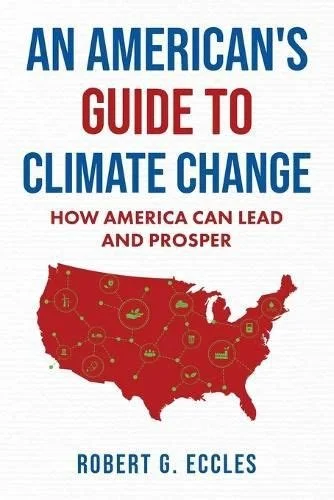
In order to prepare for this debate, I recommend to everyone who represents the majority to read Robert Eccles’ book, An American's Guide to Climate Change: How America Can Lead and Prosper. To quote Eccles directly, “This book is written for the exhausted middle—the millions who care about America’s future but are tired of extremes, false choices, and lectures from both sides. This is a conversation about how America can turn the climate challenge into an opportunity for technological leadership, job creation, and economic growth.”
Sound familiar?
Just how big is the exhausted middle?
Three separate polls provide the answer. A Gallup poll from April 2026 found that 63% of Americans say the government is doing too little to protect the environment, the highest share recorded since Gallup began tracking the question in 1992. A separate Gallup poll from March 2025 also found that 63% of Americans believe the effects of global warming have already begun. A 2024 survey from Resources for the Future found that 74% of Americans, weighted by party affiliation, consider climate change a serious problem for the country. No matter how you ask the question, it appears that the supermajority constitutes the “exhausted middle.”
What is needed
A productive discussion of climate change will take place at the intersection of three important realities: the need for an accurate narrative, a pro-growth policy approach, and the inclusion of AI and its complications.
One: Change the narrative
We will need to resist the pressure from anyone remaining on the right that dismisses the science as hoax, but also from the environmental groups on the left who communicate in apocalyptic language and advocate for radical changes to how Americans live and consume. To paraphrase Eccles, America must turn the climate challenge into an opportunity for technological leadership, job creation, and economic growth.
I am optimistic that this can happen for one simple reason: despite their political allegiance, several red states have actually led in the development of renewable energy.
One of the best examples of this is red Texas. Texas added more wind and solar capacity in 2024 than any other state and now generates roughly 30% of its electricity from renewables. Iowa gets 57% of its electricity from wind, Kansas gets 43%, and Oklahoma generates 35%. This happened because the regulatory environment was conducive to building and the resultant capacity resulted in wind and solar becoming the cheapest sources of new electricity in those states. It has also meant that rural landowners can earn revenue from turbine lease payments while still farming the land underneath and around it.
The country as a whole has also continued to make progress despite Trump’s efforts. Renewable energy consumption has continued to increase. Wind and solar together generated a record 17% of U.S. electricity in 2025, up from less than 1% in 2005, and utility-scale solar output alone grew 34%, the fastest growth of any major electricity source (U.S. Energy Information Administration). Total electrical generation from renewables has reached 25%. Despite the uptick in 2025, U.S. greenhouse gas emissions are now 18% below 2005 levels.
Two: Make it pro-growth
To do so, we have to recognize the commonality between the pro-growth requirements to achieving affordability in housing, healthcare, energy and food, and the pro-growth aspects of the clean energy transition. The focus must be on increased supply of clean energy rather than decreased energy consumption in general.
Central to the development of any renewable energy capability at scale is our ability to modernize and expand the grid as well as complete major solar, wind, and nuclear projects in a reasonable time and at a reasonable price. Fundamental to this is the pro-growth rationalization of the myriad regulatory obstacles that large projects encounter.
In today’s regulatory environment, a utility-scale solar project takes about four years on average. An onshore wind project takes about 10 years, and offshore wind about 12. In each case, the actual construction is one of the shortest phases, often under a year. According to the Energy Transitions Commission, what consumes the other eight or nine years is environmental review, permitting, and the queue to interconnect with the grid.
Eccles cites a number of examples of this problem: As of 2023, nearly 2,600 gigawatts of generation and storage capacity, more than double the country's entire installed base, was sitting in interconnection queues waiting to connect to the grid. The wait time to secure a grid connection has grown 70% over the past decade, and a typical transmission project now takes 10 to 15 years from idea to completion. A separate estimate from the World Resources Institute puts transmission timelines at up to 10 years, compared with about four years for utility-scale solar and wind projects.
Permitting reform is the most immediate priority. Research from Resources for the Future found that roughly 60% of wind and solar projects complete the formal federal environmental review process within two years, but a third of solar projects and half of wind projects take longer, and that review is only one stage in a longer sequence that also includes interconnection studies, financing, and litigation. Bipartisan proposals such as the Energy Permitting Reform Act of 2024 reflect growing recognition that the current system is incompatible with large-scale infrastructure deployment. Independent policy organizations have reached similar conclusions, emphasizing that faster permitting and meaningful environmental review are not in conflict.
Several ideas should be considered, including the imposition of statutory deadlines for environmental reviews, the consolidation of duplicative federal processes under a single agency, the establishment of federal siting authority for interstate transmission lines when states fail to act, and limits on serial litigation that delays construction.
There is ample evidence that renewables can be developed without compromising economic growth. China has built the world’s largest solar and wind capacity while sustaining rapid industrial expansion. France decarbonized most of its electricity sector decades ago through nuclear power, achieving low emissions, stable prices, and energy security without sacrificing living standards. Norway has paired decades of hydroelectric development with one of the highest per-capita incomes in the world, while Iceland built a modern, energy-intensive economy on geothermal and hydro power.
In 2025, 35 countries decreased their GHG emissions while achieving continued GDP growth. Until 2025, the US had done the same.
Three: Include AI in the debate
AI will complicate the debate. Already voices on the left are clamoring for radical impediments to data center construction, in part because of the related energy demands.
Total power demand from data centers is expected to double or quadruple over the next fifteen years. That is a direct new load on a grid already straining to keep up with baseline demand.
At the same time, AI will be critical to the development of a renewable economy. Utilities are already using AI to optimize power flows in real time and predict equipment failures before they happen. Nuclear power stands to benefit the most, since AI data centers need the kind of round-the-clock, carbon-free baseload power that only firm generation can reliably deliver. We need to make sure that AI is properly included in the discussion as it is vital to a managed, pro-growth agenda.
Let the cost advantage prevail over mandates
For the tenth year in a row, unsubsidized utility-scale solar and onshore wind were the cheapest new sources of electricity in the country, cheaper than new natural gas, coal, or nuclear plants. Solar power is now 41% cheaper and wind 53% cheaper globally than the lowest-cost fossil fuel option, according to Eccles. Battery storage costs have fallen even faster, down 93% between 2010 and 2024, which is essential to prolonging the benefits of solar and wind after the sun sets or the wind stops, according to the International Renewable Energy Agency. None of this depends on a subsidy or a mandate. It is why utilities keep building renewables even in states with no climate policy at all.
The bottom line
None of this requires anyone to accept a lower standard of living or a smaller economy. It requires America to build, permit, and connect what it already knows how to build. The exhausted middle does not want a debate about whether climate change is real. It wants proof that solving it can also make the country richer. That proof already exists. The only question left is whether either party is willing to run on it.
