
The Anatomy of Affordability
President Trump promised to lower prices “day one.” Now he derisively calls affordability a “hoax.” Democrats everywhere, however, are running on it.
While there is broad consensus on the problem, there is little agreement on the solution. Proposals range from those of The Progressive Caucus that focus on “wealthy special interests and corrupt billionaires,” and a myriad of new public assistance programs to The New Democrat Coalition’s blend of supply side incentives, subsidies, and political reforms. The leader of the party, Hakeem Jeffries, provides no detail whatsoever to support his affordability rhetoric.
Many of the promises being made are based on a misunderstanding of the issue and will fail, just as Trump has. Voters will need to decide what will work and what won’t, and that requires a better understanding of the problem.
The role of inflation - nominal versus real prices
One of the factors in what we experience as high prices is inflation. The presence of inflation makes it difficult to differentiate between real and nominal price increases. I filled my first car, a 1971 VW Beetle, for 35 cents a gallon. It held 10.8 gallons. Total: $3.78. Does that mean gas is more expensive today than it was then? Not necessarily.
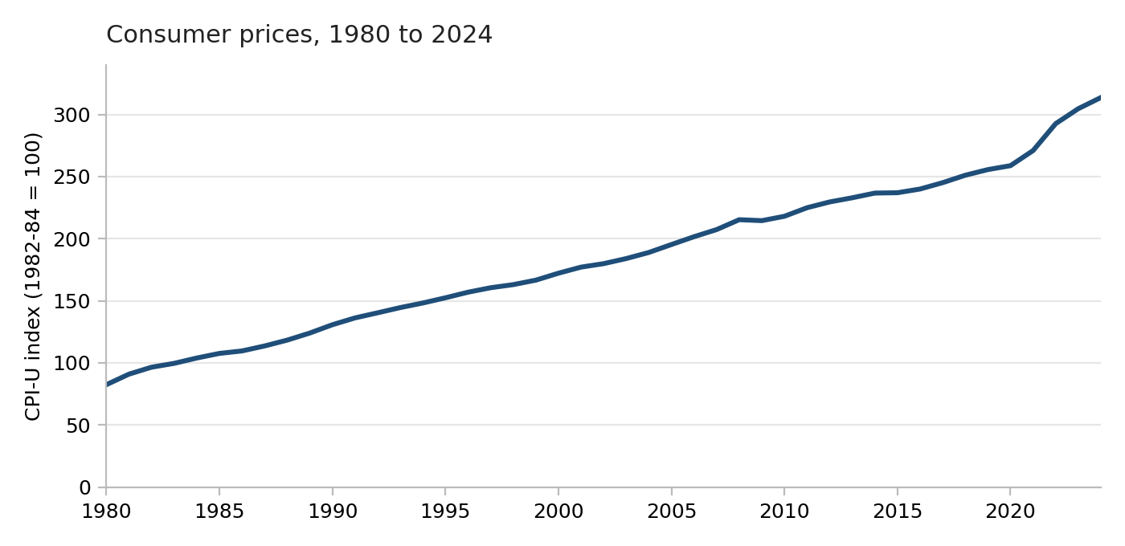
As you can see from this graph, in 1980, the Consumer Price Index stood at 82. In 2024 it was 313.7. What cost a dollar then costs about three dollars and eighty cents now. Those are nominal dollars. To understand if things are more expensive on a real basis we need to understand what has happened to incomes over the same period.
Inflation versus real incomes
Inflation over the long run is not necessarily harmful; it depends on the rate of increase of incomes. During the period in question, incomes increased faster than inflation.
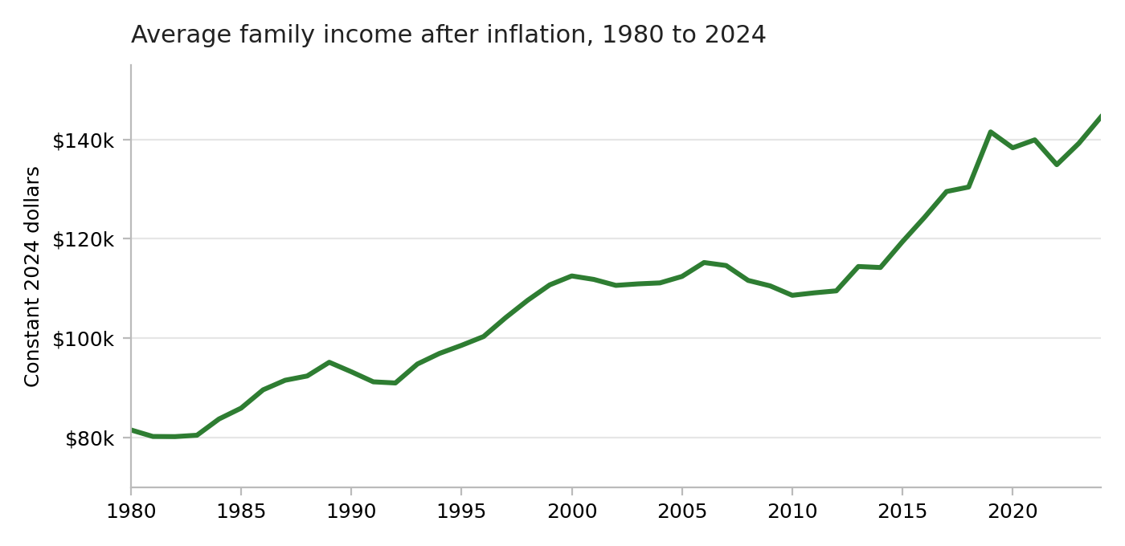
Average family income, adjusted for inflation, rose from about $81,500 in 1980 to $144,500 in 2024. (In nominal dollars, income grew sixfold while prices grew less than fourfold.) The average family, therefore, is now significantly better off.
So, even though we don’t feel any wealthier, the fact is that on average we are.
The general cost of living - most things got cheaper
Measured in this way, the general cost of living in America got substantially cheaper over the period under consideration. Things like clothing, appliances, cars, air travel, and the whole universe of consumer electronics all constitute a smaller part of household spending than they did before.
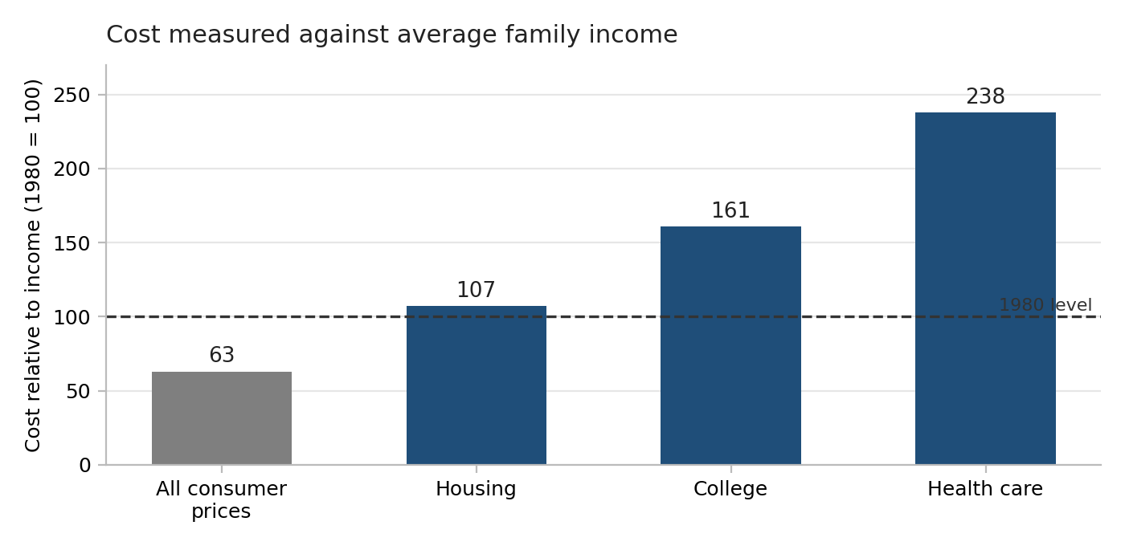
Compared to average family income, the general basket of goods and services costs about 63 percent of what it cost in 1980. That is an enormous gain, but why doesn’t it feel like we are better off?
The cost of unexpected inflation
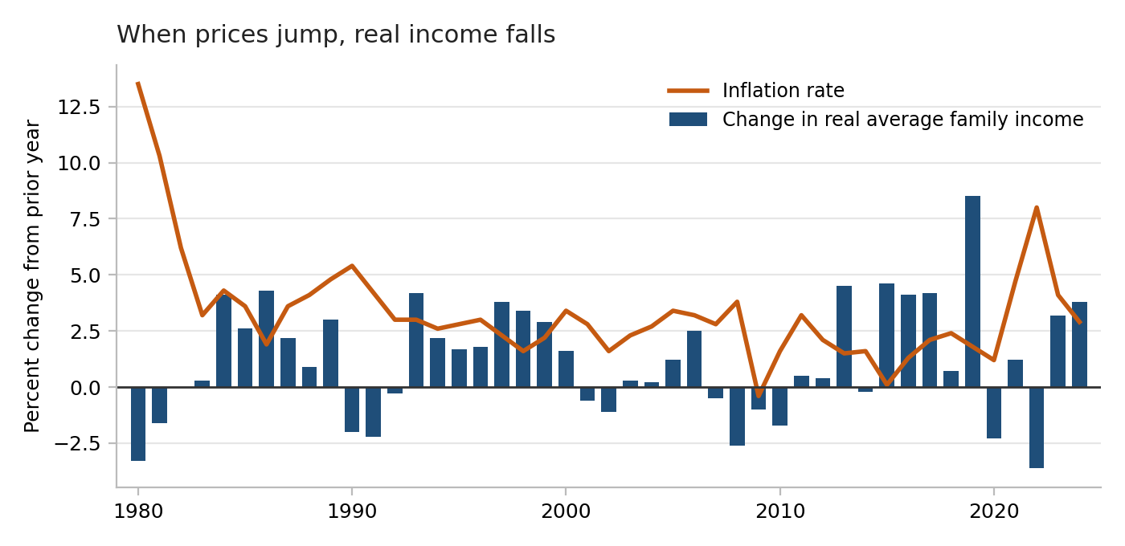
Although over the long run inflation raises nominal prices without necessarily raising real ones, this is not always the case over the short run. Income is not tied to inflation and only adjusts over the medium term. When prices jump suddenly, as they did during the inflationary period of 2020 to 2023, real incomes inevitably fall behind, and households experience a real increase in cost.
As you can see from the chart below, since 1980, real average family income has fallen in fourteen separate years. Some of those were the result of unexpected inflation, others the result of recession and lost jobs. The years 2020 through 2022 contained both. Income fell in 2020 with inflation at 1.2 percent, which was due to the pandemic. It fell again in 2022 when inflation unexpectedly hit 8.0 percent.
The specific case of food
Groceries are high on the list of those campaigning on the affordability issue. This was also true in 2024 when candidate Harris ran on the vacuous promise to make “price gouging” illegal.
Over the period of our analysis, however, the cost of food tracked general inflation almost exactly. Furthermore, money spent on food declined relative to income over this period. In 1980, U.S. consumers spent an average of 14.2 percent of income on food. By 2025, this share had shrunk to 9.7 percent. So far, so good.
What these overall trends mask, however, is what happened with the unexpected inflation of the COVID era. Food was one of the categories hit the hardest, with food inflation peaking at 9.9 percent in 2022. Since then, the rate of inflation in food has trailed general inflation.
This means that the pain Americans are feeling today at the grocery store is a residual of the unexpected inflation of the COVID era.
Some critical categories did get more expensive
As referenced above, the total basket of goods and services declined over the period relative to income. This decline occurred even though the categories of housing, education, and healthcare increased both in real terms and relative to household income.
Housing
The median home price in 1980 was $64,750. In 2024, it was $419,000. Throughout the 1990s, the price-to-income ratio averaged 3.2. It rose to a record 5 in 2022 and is 4.7 today. Contained in these numbers is the fact that first-time home buyers have declined to 21 percent of all buyers, an all-time low, and the median age of such buyers has reached an all-time high of 40.
College education
A year at a four-year college, counting tuition, fees, room, and board, ran $3,167 in 1979-80. That was 14 percent of average family income. By 2022-23 it was $30,884, or 23 percent.
Healthcare
National health spending was $1,067 per person in 1980. In 2024 it was $15,474. While general prices rose less than fourfold, health spending per person rose more than fourteenfold. Part of this is because we consume far more medical care today than we did on average in 1980. Adjusting for this behavioral change, medical care CPI still rose more than twice as fast as general CPI over the period.
What accounts for this? The answer is complex and differs across the three categories. Simplistically, however, housing supply has been limited by local regulation, the most prominent of which is zoning. Healthcare has grown in technological and administrative complexity, but regulation has also reduced the number of doctors and hospital beds per capita. Education has enjoyed a monopoly status for generations and government support has shielded it from competing on price.
Despite these differences in cause, a commonality is the presence of obstacles that have prevented the market from providing supply equal to demand. When supply fails to meet demand, real prices rise.
Free market outcomes
When markets are entirely free and supply is allowed to rise with demand, competition often results in a decrease in price. Look here at the price behavior of several unregulated consumer goods categories since the mid-eighties compared to those that have been more highly regulated.
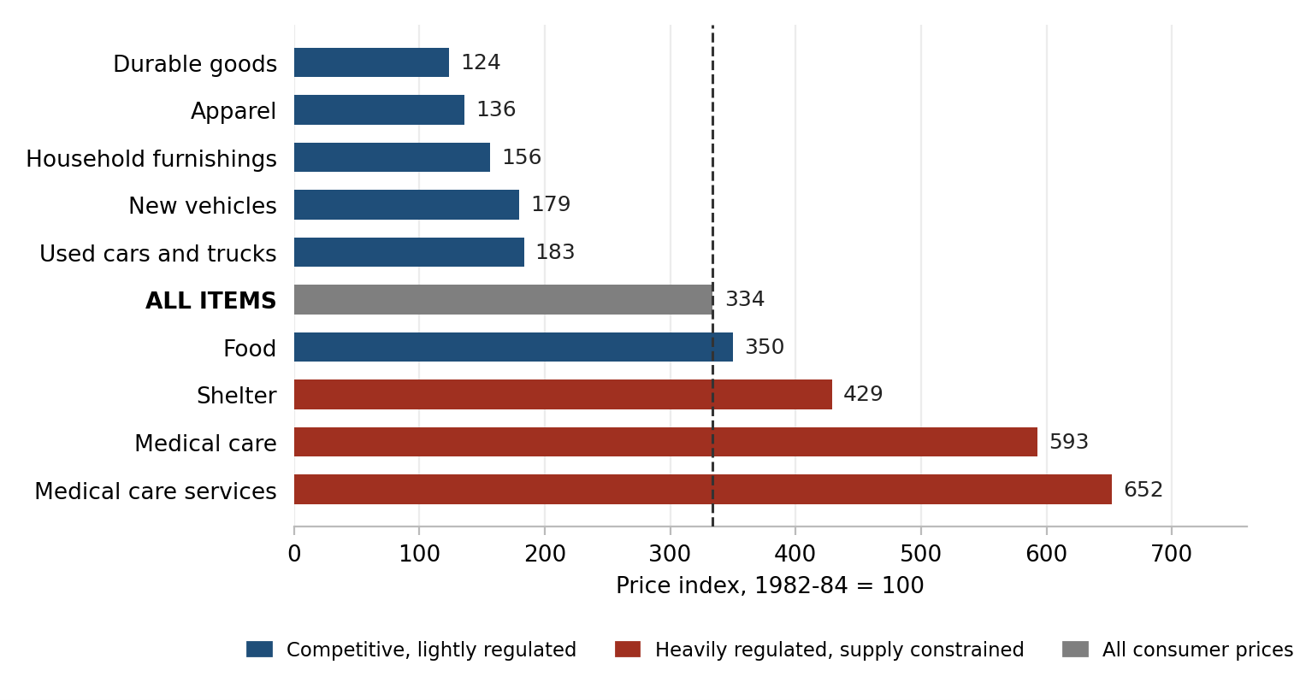
Also interesting to note is that from 1997 to August 2015, the price index for televisions (adjusted for quality) fell 94 percent. Personal computers fell 96 percent. Audio equipment fell 60 percent. Photographic equipment fell 59 percent. Over the same stretch, prices generally rose about 48 percent.
Nobody passed a law making televisions or apparel or new cars more affordable. Producers were free to build more of them, and they did. Supply met demand and the price came down.
Affordability, therefore, is three things - not one
First, inflation over the long run gives the impression that things in general are more expensive when in fact, relative to incomes, they are not. Politicians should acknowledge this and thank the free market for it.
Second, the unexpected inflation of the COVID era exceeded the increase in incomes and did result in everything becoming less affordable. This was the result of poor Federal Reserve policy and was entirely avoidable. Here, politicians should place the blame on the Federal Reserve, as has Chairman Warsh in his public testimony, and move on. See my recent Substack: The Federal Reserve’s Role in a Pro-Growth Agenda for a fuller discussion of this issue.
Third, in sectors where government has interfered in the market, prices have increased on a real basis and as a percentage of household budgets. In these areas, politicians should focus on pro-growth proposals.
Real affordability is a supply problem
The obstacles to faster growth are a mystery.
In housing, these include restrictive zoning, minimum lot sizes, parking mandates, discretionary review of projects that already comply with the code, environmental reviews used as a delay tactic, and rent regulation that suppresses new construction.
In health care, we have an administrative apparatus that consumes a large share of every dollar spent, certificate-of-need laws that require state permission before a provider may add beds or equipment, residency slots capped by federal funding, scope of practice rules that keep trained clinicians from practicing to their training, and the cost of frequent litigation.
In education, accreditation rules protect incumbents against new entrants, a subsidized loan system lets institutions raise the sticker price without losing customers, and administrative headcount has grown faster than teaching headcount for decades.
While most of this was well intended, the unintended consequence has been slow growth.
Real versus spurious solutions
Any policy proposal intended to reduce the obstacles to a free market and encourage the increase in supply is a good start. Remove the obstacles and prices will come down, exactly as they have come down everywhere else in the economy. This approach costs nothing.
The 21st Century ROAD to Housing Act became law with bipartisan support on July 11th. Although most of the impediments to housing growth are at the state and local level, this bill is a good example of an effort to address the federal components of the problem with pro-growth solutions.
Policy proposals that are based on making things “free,” providing subsidies, loans or tax credits will not fix the problem - they will worsen it – by increasing demand without increasing supply.
And of course, the fringe proposals of “taking on the wealthy special interests and corrupt billionaires” are red meat for the fringes in the base but can’t be translated into substance. These promises fall into the category of Trump’s day-one promise and are destined to fail.