
Part three of three: A blueprint for U.S. healthcare reform
In part one, “What we spend and what we get,” we showed that we pay considerably more for our healthcare in America while failing to provide universal coverage and achieving poorer outcomes.
In part two, “How other countries do it,” we learned that our peers provide healthcare in very different ways, but that their systems are all universal, coverage is standardized, prices are negotiated, and administrative costs are relatively low.
The question for this article is what can be done?

As we learned from our peers, we need to expand supply, reduce costs, provide universal coverage, and improve our outcomes. Providing universal coverage will improve outcomes in the areas that the medical system controls. (A portion of our outcomes gap is a function of gun violence, drug overdoses, and automobile deaths.)
In 2024, peer countries spent an average of 11.2 percent of GDP on healthcare while insuring everyone. We spent 17.2 percent. Here are the components of that difference.
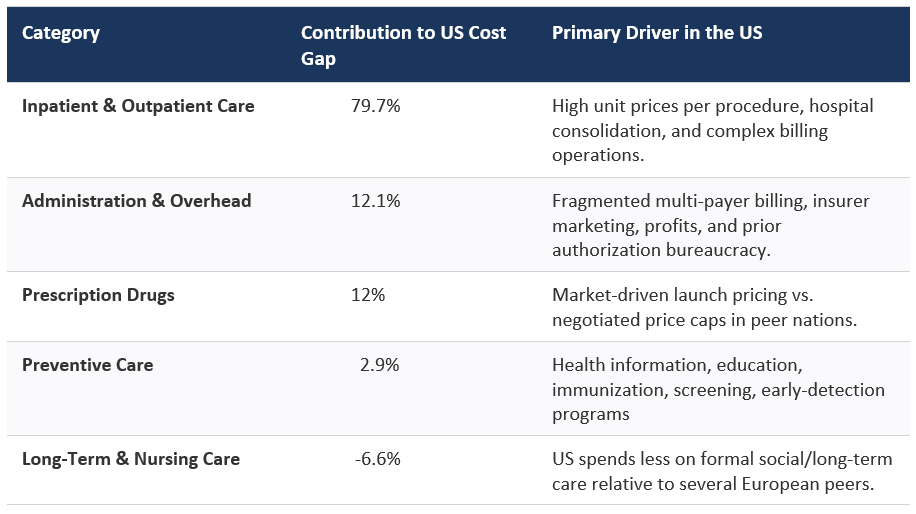
*Several of these cost comparisons have overlapping solutions, and the analysis that follows will overlap as well. For example, reducing the cost of administration lowers the Administration and Overhead category and the cost of inpatient and outpatient care at the same time.
Reform must be designed to address these cost gaps, and we can do so by adopting the best practices of our peers:
Create greater supply of healthcare services
Set prices for inpatient and outpatient care under a standard minimum program definition
Simplify the administration process
Negotiate the prices of drugs
Provide universal coverage
Closing the gap between our spending rates and those of our peers would save 6 percent of GDP, or approximately $2 trillion per year. Approximately $200 to $300 billion of that savings would be realized by Medicare and Medicaid. Even Medicare and Medicaid savings of $135 billion would enable universal coverage of the 27 million uninsured Americans.
A brief lesson from the Affordable Care Act (ACA)
Creating greater access through public subsidies, without addressing supply and cost, will fail because the cost is unsustainable. This was one of the flaws of the ACA.
In America's Bitter Pill, Steven Brill described the Obama administration's conclusion that controlling costs meant fighting the American Medical Association, the hospital systems, the insurers, the device makers, and the drug industry at the same time. According to Brill, the administration concluded that the fight could not be won. Instead, it focused more on increasing access than on reducing cost or increasing supply.
Every country we profiled in part two solved cost and coverage together. The ACA increased coverage without controlling costs, making it a vulnerable target of Republican opposition.
Lowering hospital and provider costs: expand supply and regulate rates
This category is the single largest disparity between us and our peers and may be the most difficult to address.
First, stimulate greater supply:
Use the influence of the federal government to encourage universities to expand enrollment in medical, nursing, pharmacy, and related health programs.
Increase the number of residencies. Most residencies are paid for by Medicare, and that number is determined by Congress. Even without increasing the number of student positions, the number of residency applicants exceeds the number of residencies available.
Fund medical education publicly, as many of our peers do. Debt pushes graduates toward the procedural specialties and away from primary care. Not unlike the military, tuition could be paid in exchange for a commitment of years in primary care or a shortage area.
Increasing the supply of physicians and registered nurses will put downward pressure on salaries. U.S. primary-care physicians earn about twice our peer-country average while registered nurses earn about 1.5 times.
Increase the use of licensed staff. About half the states let nurse practitioners diagnose and prescribe without a physician agreement. The same argument applies to pharmacists, who in a growing number of states may test for and treat routine conditions. Do the same for internationally trained physicians, who in 20 states now have a licensing pathway that does not require repeating a U.S. residency.
Standardize licensing across state lines. While most states now have expedited licensing processes, a single national license would expand supply through telehealth.
Limit the restrictions on building new physical capacity. In 35 states and the District of Columbia, a provider must prove community need before building or expanding a facility, and existing hospitals are allowed to object to the application. Tennessee voted in 2026 to end the requirement for most acute care hospitals by 2030. Every state should, and the exemption should extend to outpatient sites, where care can be provided at lower cost.
Similar to the strategy many states are employing to increase housing, reduce the zoning and permitting requirements for medical facilities of all kinds in order to increase the speed and lower the cost of construction.
Second, regulate prices:
Hospitals already report being economically strained. However, since we know that our peers provide the same services at lower cost, we can learn from them how to run our hospitals more efficiently. Reducing administrative requirements will help, but setting prices will force hospitals to adjust. In competitive markets, companies under price pressure find ways to cut costs. Hospitals and outpatient providers will do the same.
Our peer countries provide the model for setting prices. In this country, Maryland also provides an interesting example of what standardizing hospital rates can and cannot do. In 2014, with the Maryland All-Payer Model, the state established global budgets for Maryland hospitals to reduce hospital expenditures and improve care. Since then, the program has evolved as the Total Cost of Care Model and most recently the AHEAD model. Hospital use has fallen, Medicare spending per beneficiary has dropped, and the cost growth for private payers and employers is among the slowest in the country.
Litigation in America drives the high cost of malpractice insurance and is a factor in salaries and hospital costs. The CBO estimates that tort reform, including settlement limits and caps on damages, would reduce total health spending by about 0.5 percent. While it isn’t a lot, it is worth the effort.
Slash administrative waste through standardization
On a recent vacation in France, I needed to see a doctor. I went online to a website called Doctolib where I could see all the doctors in the area and their schedules. I made an appointment through the app. The cost was 40 euros. The treatment was the equivalent of what I would receive at home for $350. The difference was that there was no receptionist and no team of administrators processing claims. Had I been a French citizen, I would have provided my Carte Vitale, which gives the doctor access to my health records. Unlike in the U.S., French recordkeeping is centralized. The Carte Vitale would also provide access to my bank information for reimbursement.
Unlike the French and other peer systems, the U.S. relies on thousands of competing private plans alongside Medicare and Medicaid. Every insurer maintains distinct formulary rules, claim submission formats, and prior authorization requirements.
Hospitals and physician practices employ large staffs of billing specialists, coders, and claims managers to navigate individual insurance rules, adjudicate claims, and handle complex collections. Private insurers also allocate significant revenue to marketing, plan underwriting and profit, on top of the pure cost of processing claims. U.S. clinicians spend an estimated 10 to 15 percent of their working hours on paperwork, prior authorizations, and regulatory compliance.
Administration accounts for 7.6 percent of U.S. health spending against 3.8 percent in peer countries. That measure counts insurers and the cost of running government programs. It does not count the administrative work embedded in hospitals and physician offices. Estimates that include that work put total U.S. administrative spending at 8 to 15 percent of health spending.
A single standardized benefit package and fee schedule would significantly reduce this unproductive expense.
Our own Medicare shows that it works. Its administrative costs are competitive with our peers. The program standards are set centrally, and private insurance companies process the claims. CMS contracts with 12 regional Medicare Administrative Contractors, which it describes as private health care insurers awarded a geographic jurisdiction to process Part A and Part B claims.
This model could be expanded to include a national network of regulated nonprofit administrators who compete based on service rather than on risk selection, administering a single benefit package and a single fee schedule, without the need to underwrite or profit on denials.
Reduce the cost of drugs: pay what our peers pay
We pay more than any other country for the same medicines. In 2022, U.S. manufacturer gross prices were 278 percent of prices in 33 OECD countries, and brand-name drug prices were 422 percent.
During the Biden administration, Medicare obtained the right to negotiate prices for a short list of drugs. The negotiated prices for the first 10 Part D drugs took effect on January 1, 2026. Those prices were still about 2.8 times the average paid in peer countries.
During his first administration, Trump proposed setting the price of drugs at the average level other countries pay. This is the right approach. As of August 2026, 26 manufacturers have agreed to sell to state Medicaid programs at prices tied to European levels. Unfortunately, it is far too narrow, as it does not address Medicare or employer coverage. We need to insist on paying no more than our peers pay for the same drugs.
Provide universal coverage: the foundation of outcome improvement
Addressing costs in this way is what makes universal coverage affordable. A standard minimum benefit package is the precondition for a single fee schedule and a single claim format, and a population that is fully enrolled is the precondition for a risk pool that spreads risk efficiently. Every peer country provides universal or near-universal coverage and publicly finances or subsidizes care for those who cannot afford it.
Our failure to achieve the outcomes our peers achieve is in part due to the fact that 27 million of our citizens are uninsured and have reduced access to preventive healthcare. One in six Americans reports that they routinely skip or delay healthcare due to cost. By providing universal coverage and expanding access, we can begin to close the outcomes gap.
The bottom line
None of this requires abolishing private insurance, ending employer coverage, or winning the Medicare for All argument first. It requires setting prices, standardizing the rules, training more clinicians, letting people build, and covering the people who cannot pay.