
You’re Politically Independent, and You Are Unrepresented
A few years ago, I wrote a piece for here called “A Majority Without Representation.” My argument then, and my argument now, is that when you look at where Americans actually stand on the major issues, a clear majority holds sensible, moderate, centrist views that neither party represents. I believed then, and I still believe, that properly represented, Americans would be able to reach agreement at least directionally on how to address our most pressing problems. The details of execution surely would require debate and compromise but at least we would have a consensus upon which to try.

Since then, while the Republican and Democratic parties have grown even further apart, the middle has continued to grow larger. And yet, we are still being ignored.
The Independent Plurality
When I wrote A Majority without Representation, independents represented 40% of the electorate. As of last year, according to Gallup’s 2025 annual survey, a record 45% of Americans now identify as political independents — the highest level ever recorded. Democrats and Republicans each account for 27%. We are the largest single group in the country. We are a plurality of Americans who have decided that neither party deserves our loyalty.
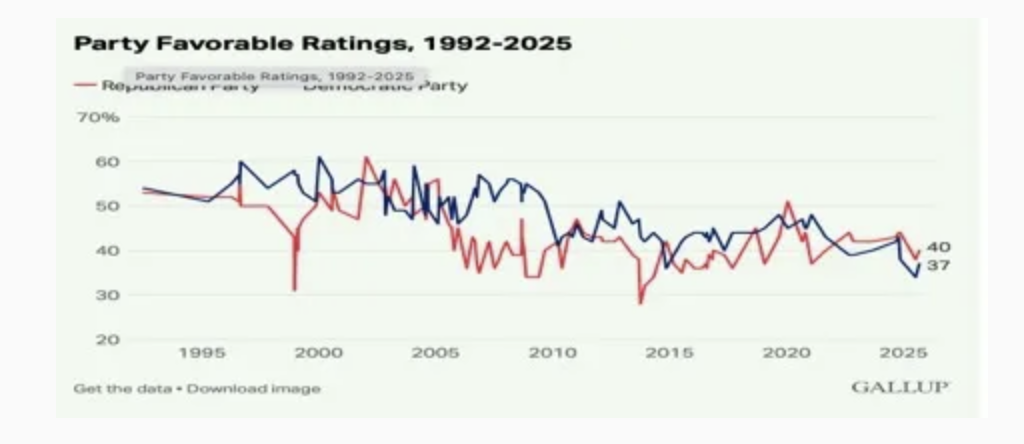
And here is what should embarrass both parties: Gallup reports that the both parties’ favorability ratings are stuck at some of their lowest levels in three decades of tracking. Since 2010, majorities of Americans have viewed both parties unfavorably in every single Gallup reading. People are not choosing sides. They are leaving them.
How to Find the True Majority
Most surveys report results for Democrats and Republicans only. That misses us entirely.
To find what Americans actually believe, I use a simple methodology. Where three-way polling exists — broken out by Democrat, independent, and Republican — I weight each group by its actual share of the population: 27% Democrat, 45% independent, 27% Republican. The result is a weighted average that reflects the country as it is, not as its party activists imagine it to be.
Where three-way polling does not exist, I use clear overall majorities only — no extrapolation, no guesswork. Either way, the same picture emerges: Americans agree on the problem. They are frustrated by the extremes of the proposed solutions. And they have no one to vote for who reflects that position.
What We Actually Agree On
Healthcare. This is now one of the top domestic concerns in America, according to polling by both Gallup and Fox News. A 2026 Gallup survey found that 80% of Democrats, 66% of independents, and 31% of Republicans describe themselves very worried about healthcare. Weighted by actual party share, that is a 60% majority. Fox News polling in late 2025 found that 86% of Americans are very or extremely concerned about the price of healthcare. On the specific fear of medical debt, 71% of Democrats, 67% of independents, and 62% of Republicans report being very or somewhat concerned, producing a weighted majority of 66%. Nearly 85% of Americans say they are at least somewhat worried about healthcare — more than any other issue measured.
Social Security and Medicare. A West Health-Gallup survey found that 71% of Democrats, 66% of independents, and 62% of Republicans under age 65 worry that Medicare will not be available when they become eligible — a weighted average of 66%. Overall, 80% of Americans report being worried or extremely worried about Social Security’s future, a 15-year high. These are not partisan concerns. They are generational ones.
The Federal Debt.A Peterson Foundation’s Fiscal Confidence Index found that 75% of Democrats, 79% of independents, and 82% of Republicans want reducing the debt to be a top-three priority for Congress and the president. The weighted average is 79%. While these numbers are clear that Americans of all affiliations agree that the growing level of debt is an issue, it is likely that there is less agreement on the strategy for dealing with it.
Gun Control.Gallup’s October 2024 survey found that 89% of Democrats, 56% of independents, and 25% of Republicans favor stricter gun laws, producing a weighted average of 56% — a clear majority. Support for an assault weapons ban tracks similarly.
Climate Change. A March 2025 Gallup poll found that 91% of Democrats, 66% of independents, and 31% of Republicans believe the effects of global warming have already begun — a weighted average of 63%. A 2024 Resources for the Future survey found that 96% of Democrats, 73% of independents, and 55% of Republicans consider climate change a serious problem for the country if nothing is done, producing a weighted majority of 74%. Where the consensus breaks down is on how to fight climate change and at what cost. While many Americans will not accept an approach that sacrifices economic growth, that is not denial. It is simply a reasonable condition for action that neither party has satisfied.
Meanwhile, Nothing Gets Done
If these majorities are real, one would expect to see progress on the issues that are important to them. Or at least a modicum of effort. Alas, there is very little. In fact, in several cases, the current administration is working against the consensus.
On Social Security and Medicare: Congress passed the One Big Beautiful Bill Act in July 2025. Rather than shoring up the trust funds, the legislation accelerated their depletion. The math here is not political. It is actuarial. The 2025 Trustees Report projects that the Social Security trust fund will be unable to pay full benefits by 2033, at which point if nothing is done benefits will face an automatic 23% cut. Medicare’s Hospital Insurance trust fund also, and coincidently, faces depletion by 2033 at which point benefits will only be 89% of what is required.
On the cost of healthcare: It is well known that The Big Beautiful Bill suspended the premium tax credit for millions of Americans. On a more structural issue, the physician shortage in America continues to worsen, raising costs and reducing healthcare availability. The Association of American Medical Colleges projects a shortage of up to 86,000 physicians by 2036. The cause is straightforward: Congress capped Medicare-funded residency slots in 1997 and has barely moved since. A bipartisan bill — the Resident Physician Shortage Reduction Act of 2025 — would add 14,000 residency positions over seven years. While far more is needed, there is no excuse for even this minimal effort to sit in Congress with broad support and no action.
On climate: In addition of course to withdrawing from the Paris Accords, the current administration has revoked offshore wind leases, halted permitting for new wind and solar projects on federal lands, and suspended construction on all large offshore wind projects under development. Courts have blocked some of these actions. The broader pattern — unwinding progress rather than building on it — remains intact.
On the debt: While Republicans since Reagan have campaigned on reducing the national debt, the reality is that once in office they generally have done the opposite. Most egregiously, The Big Beautiful Bill will add an estimated $3 trillion to the federal deficit over the next decade. Federal spending bills, regardless of which party writes them, consistently produce larger deficits. The 79% of Americans who want the debt addressed cannot name a single legislator making it the organizing principle of their career.
The Parties Are Losing People to the Middle, Not to Each Other
The parties are not losing members to each other. They are losing them to us. And rather than asking why, they are doubling down on the approaches that drove people away. Gallup finds that in 2024, the share of remaining Republicans identifying as very conservative/conservative and remaining Democrats identifying as very liberal/liberal both reached record highs. The parties are becoming more extreme as the country moves in the opposite direction.
We Need to Speak Up — and Show Up
I write not as a professional activist or politician, but as a private citizen who thinks independently about the issues and cannot find his views represented by either major party. I suspect many of you feel the same way.
While I could argue that several institutions established by our constitution have outlived their usefulness — the electoral college and two senators per state for example — that is a subject for another day. For now, the path to a better future runs through the primary process. If you are registered with one party or the other, get out and vote for the moderate voice. If you are in state where independents can vote in primary elections, do so, and vote for the moderate. If we showed up in sufficient numbers, we could stop nominating candidates who represent the 27% and start producing candidates who might govern for the 45%. The right and left wing fringes of the parties survive because the rest of us let them.
I would offer the Commonwealth of Massachusetts as an example of good compromise and governance. While the state leans left on average, many of our residents, particularly from the western part of the state, are not. We routinely elect governors who govern from the center, who do so without drama, who get along with the typically liberal mayors of Boston, and who represent all of us as well as possible. Mitt Romney (R), Charlie Baker (R), and now Maura Healy (D) are all good examples of this tradition. At a recent fundraiser, and just after attending the National Governors Convention, Healy made the observation Democratic governors nationwide are getting things done, and governing from the center: “AOC and Hakeem Jeffries are not the sole voice of the Democratic party” she said.
We are the plurality without representation. The first step toward changing that is acting like one. Get out and vote. Make your voice heard. Write something on Substack!