
Greetings from Paris, France.
I’ve been coming here since I was a student in college. Studying the language, walking the streets of Paris, and exploring the hilltop towns of the Luberon are, for me, pleasures that never cease. I love the French and admire their passions. Although the recent protests have made this trip different from all others, they have also given me an opportunity to witness the difference between news that is made and how it is reported or characterized.
On October 7, the WSJ editorial board published an opinion entitled “France’s Bonfire of Inanities.” Its subhead: “Leftists riot in defense of a welfare state the country can’t afford.”
In a recent post, J. D. Vance said, “I pray that France, a beautiful country of amazing people, will stop this madness before more of its landmarks burn,” he continued. “And I hope Americans are paying attention. This is the future congressional Democrats seek for your country.”
Meanwhile, Trump posted: “The migrants have taken over France, they must CLOSE THE BORDERS, FAST!”
They are right that the French are protesting. Virtually every other observation they have made, however, is wrong. And it isn’t just wrong; it reflects an ignorance of the facts on the ground and is blinded by their belief in the universality of American exceptionalism.
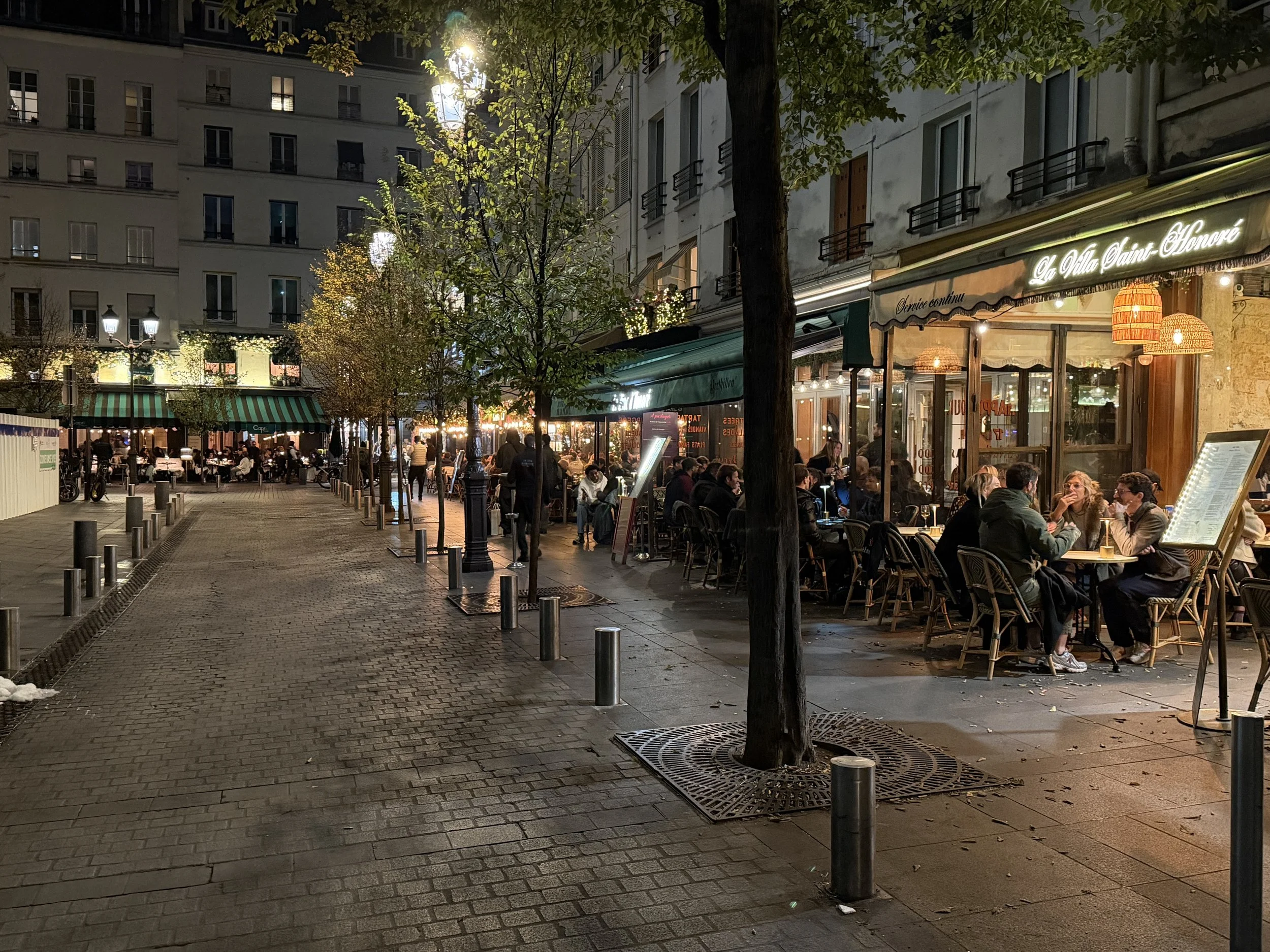
Picture taken from my table during dinner Saturday night in Paris – does this look like a city on fire?
Protest is a French tradition
Protesting is part of the political process here. Since my first time in France, I’ve witnessed protests by workers of electric utilities, SNCF, and the Paris Metro, as well as taxi drivers, air traffic controllers, farmers, and garbage collectors. Many result in some form of policy change, as they already have during the current round.
Therefore, to conclude that things must be really bad, that the “socialist state” is breathing its last breath, simply because they are engaged in a practice that is as old as the French republic misses the point. They are protesting conditions they are dissatisfied with – it doesn’t mean those conditions are worse in an absolute sense than similar conditions in America. In fact, when I compare the many challenges facing our two countries, I find just the opposite.
So far, Americans have chosen a combination of denial and protest at the ballot box. But if our elected leaders don’t begin to face our problems head-on, no one can guarantee this will always be the case.
What are the facts on the ground?
The current round of protests started with students in September and early October. In France, teachers are paid by the central government, but school facilities are maintained by local governments through property taxes. Students in less prosperous areas have been upset by the conditions of their school buildings, while others complain about overcrowding of their classrooms, programming, and the college application process. Students began the protests and were quickly joined by sympathetic faculty.
The profile changed with the protests of October 17, when the core student and faculty protesters were joined by groups not associated with the school-based movement. On that day and the three Saturdays since, the theme of the protests expanded to include complaints about the cost of living, the price of gas, the minimum wage, as well as the cost/benefit of many government services.
Unfortunately, a minority have engaged in violence and looting alongside the peaceful protesters. The French refer to them as “casseurs” - vandals who smash property, especially during demonstrations.
Their problems are real, and so are ours
Let’s start where the French unrest started: the condition of schools.
Apparently, neither Trump nor Vance have ever stepped foot in an inner-city school in Boston, New York, or Chicago. I’ve been in many. And I can tell you that if they were to, they would find plenty of crumbling school buildings covered by graffiti and protected by barbed wire. It is a fact of life that schools dependent on property taxes of low-income communities are often of lower quality than schools in wealthy communities.
And what about the French complaint that they don’t like the college admissions process? Note I said “process” because in France everyone can go to college and college is effectively free. Compare that to the U.S. where many high school graduates can’t get into college or simply can’t afford it. Consider also the fact that 42.6 million Americans currently owe $1.64 trillion in federal student loans, 42% of recent college graduates work in jobs that typically do not require a degree, while the unemployment rate of recent graduates of 5.6% exceeds the national average.
And what about the complaints of those who have recently joined the students as the protests have grown?
Shall we start with the cost of living? Does anyone think that the recent midterms didn’t reflect a deep and broad dissatisfaction with affordability in America?
And what about the accusation that France is a failed socialist state, drowning in debt? While the country’s debt has now reached a problematic level, the U.S. is also experiencing some limits on its borrowing capacity. Let me give you a few economic indicators.
Total government debt (as percent of GDP): France at 119 percent versus the U.S. at 127 percent, inclusive of state and local debt.
Annual deficit (as percent of GDP): France at 5.1 percent versus the U.S. at 6.1 percent.
Annual interest expense (as percent of GDP): France at 2.2 percent versus the U.S. federal government at 3.4 percent. Add state and local spending and the difference is even greater.
Annual interest as a share of spending: France 10.5 percent versus the U.S. at 15.5 percent.
Social Security and Medicare: As is now common knowledge, the Social Security retirement trust fund will be exhausted in the fourth quarter of 2032. Unless Congress acts, benefits will be automatically cut by 22 percent. Medicare’s hospital insurance trust fund runs out in the second quarter of 2033.
The size of government: When viewed simplistically, the French tax and spend a greater percentage of their GDP than we do. By the IMF’s count, French public spending this year is 57.4 percent of GDP, against 37.9 percent for all levels of government in the U.S. However, Americans pay privately for much of what the French state provides. When you adjust our number by the fact that most French pensions, healthcare, and college education are covered by the state, the gap narrows considerably.
Regardless, the French aren’t protesting the size of their government, they are protesting the quality of the services they are receiving. Again, is any American truly satisfied with the customer service levels of the SSA, the IRS, or your local DMV?
Where America outperforms
The U.S. has the advantage in its growth rate and lower level of unemployment. Over the past 20 years, the U.S. economy has grown an average of 2.0 percent per year, net of inflation, against 1.1 percent for France. Unemployment averaged 5.8 percent versus 8.7 percent in France. We have a more deeply entrenched entrepreneurial culture than France. As a result, the level of innovation in the U.S. generates superior growth, wealth, and employment. France, in contrast, has a legacy of strict work rules that many economists believe, as do I, stifle growth.
French centralization provides an easy target
We also differ in this simple way: France is a relatively centralized government. While it has local governments, the bulk of services are provided by the central government. This makes the central government an easy target for public dissatisfaction.
Americans may be drowning in student debt, but there isn’t a central way to vent this anger. Inner-city kids may be unhappy with the failing schools, but again, this is a local issue repeated nationally, and not therefore conducive to centralized protest.
Farmers are deeply unhappy with the price of diesel, but in the U.S. the farm lobby is such that they can obtain billions in subsidies without resorting to protest. Americans at large are unhappy with the cost of living, the price of gas, etc. but they vented their anger at the polls on November 3 and not yet on the streets.
The U.S. is no more realistic about its limits than are the French
None of this should be interpreted as an unequivocal endorsement of the French system. I believe they should have better control of their debt levels, manage their spending more efficiently, and relax their overall regulatory environment in order to create greater innovation and economic growth. I also believe that their opposition to Macron’s efforts to raise the retirement age is downright childish.
Having said that, I think the U.S. has no right to point the finger when our own house is in disorder. Their bills may simply come due sooner than ours. Our advantage here should not be construed as something we have earned - it is largely a function of the fact that ours is still the reserve currency of the world. We borrow in our own currency. We can, as the Federal Reserve has done, monetize our debt and reduce the real burden of our obligations through inflation. The French don’t have that option.
Meanwhile, we have done no more to address our growing debt or deficit than have the French. To the best of my knowledge, not a single candidate in the midterms campaigned against the irresponsible spending in Washington. Similarly, we have done nothing to reform Social Security, nor was it a topic during the recent campaign. We have a healthcare system that is becoming unaffordable, an overpriced and inadequate college education system, an infrastructure that ranks low compared to our OECD peers, and a military that has just been humiliated by a country with a fraction of our resources.
A reckoning is coming to America and every Western country that has kicked the fiscal ball down the road. When it does, it may not manifest in the streets, as is the French custom, but it will manifest.