
It isn’t Just the Democrats who Have a Definition Problem
Last week I wrote about the Democrats' problem: they have let themselves be defined by opposition to one man, with no governing agenda to replace it. That piece is called “Stop Talking About the Reflecting Pool,” and you can find it on the site.
But here is another reality that merits attention: The Republican Party has the same problem, and it is even more problematic. While the Democrats have been defined by what they are against, the Republicans have been defined by two things. First, by who they are for, and the man they are for does not have a coherent governing philosophy. He has positions that are actually anathema to the doctrine of traditional conservatism. And second, by his abuses of power that they have silently condoned.
For my entire life I have identified as a small-government conservative with socially liberal values. I believe in free markets, balanced budgets, a strong defense, and social programs for the truly needy. At the same time, I think people should have the right to love who they want and worship as they want.
When Ronald Reagan left the Democratic Party, he was fond of saying “I didn’t leave the Democratic Party, it left me.” I feel the same. When the Republican Party through Donald Trump abandoned its traditional conservative positions, meaning the positions of George Will, Bill Buckley, and presidents from Dwight Eisenhower to George H. W. Bush, it left me.
It is not surprising, therefore, that I still have many of my friends who call themselves conservative. What is surprising is how many of them have remained loyal to the party despite Trump’s lack of adherence to traditional conservative values. The question for them now is once Trump is gone, what will the party become? How will it redefine itself from the cult of Trump to a party with a coherent governing philosophy? And second, how will they trust the ethics of members of the party who have underwritten Trump’s assault on our institutions?
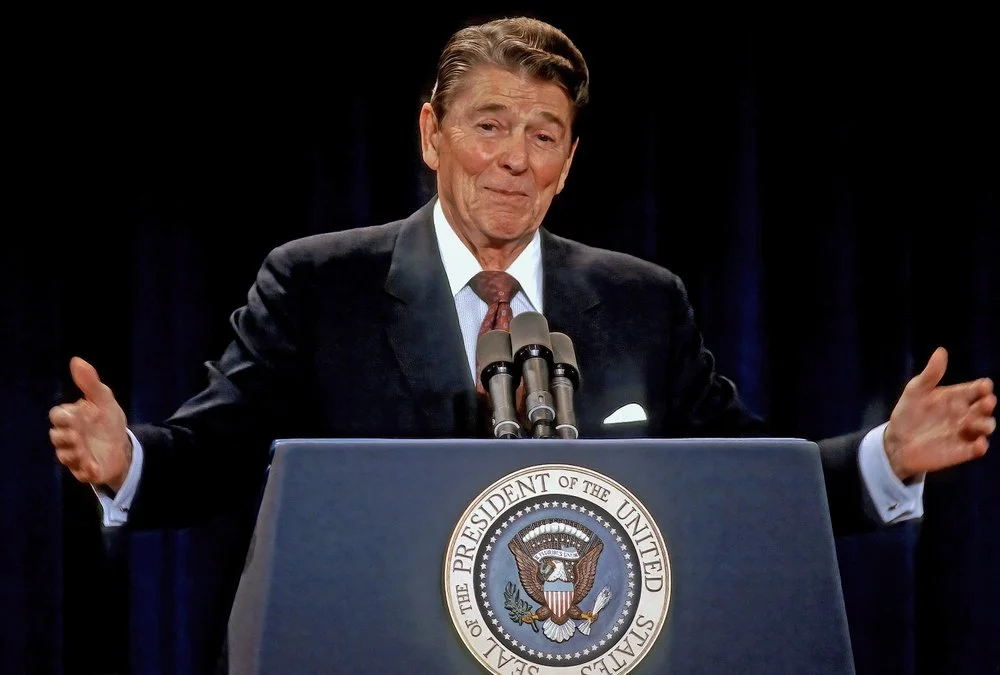
The cult of Trump versus traditional conservative values
There is no single definition of conservatism, but for the sake of discussion, I will use the policies of the conservative icon Ronald Reagan as the working definition. Here is what we find when we compare his brand of conservatism to the cult of Trump.
Fiscal Restraint: Reagan and every Republican since has run on the same line. Reagan put it as plainly as anyone ever has: “We don’t have deficits because people are taxed too little. We have deficits because big government spends too much.” Newt Gingrich’s 1994 Contract with America made a balanced budget amendment and a line item veto the first plank of the Contract.
Although we know that they all failed to govern consistently with their rhetoric (Reagan nearly tripled the national debt), Trump was the first to make no pretense of balancing the budget.
Each of his signature tax bills added record amounts to the nation’s debt. The One Big Beautiful Bill Act, scored by the nonpartisan Congressional Budget Office, will add $3.4 trillion to the deficit over ten years.
Free trade: Reagan liked to quote the French economist Bastiat who said protectionism is: “the sacrifice of the consumer to the producer, of the end to the means.” Accordingly, Reagan rejected tariffs and quotas on multiple occasions as president, based on his correct understanding that trade barriers are little more than a tax on your own citizens.
Trump, in contrast, has advocated for tariffs his entire life and imposed them at record levels on Liberation Day in 2025. If not for the Supreme Court finding them to be illegal, they would surely be in effect today.
Free markets: This requires little definition. Government should set the rules when absolutely necessary but then let the market function and let the best product prevail. It should never pick winners and losers, and it certainly should never advocate for government ownership of any means of production.
Again to quote Reagan, "We who live in free market societies believe that growth, prosperity and, ultimately, human fulfillment are created from the bottom up, not the government down."
Once again, Trump has taken a different view of the role of government in the markets. He picked winners and losers through selective imposition of tariffs. He took a equity stakes in Intel and in the rare-earth miner MP Materials. When Nvidia sought permission to sell chips to China, Trump demanded a share of the related revenues. When media companies seek approval to merge, he extracts editorial concessions.
Strong alliances and distrust of Moscow: Reagan called the Soviet Union an evil empire and meant it. He also said NATO had to be strong enough “that no adversary would think even for a moment that war might pay.” For forty years, skepticism of Russia and faith in the NATO alliance were fundamental Republican positions, as they often charged the Democrats with being “soft on defense.”
This spring Trump called NATO a “paper tiger” and told reporters he was “absolutely” considering withdrawal. He has told allies directly that the United States would not defend a NATO member that did not pay enough into the alliance, and has been described even by his own former national security advisor as exhibiting “objectively pro-Russian behavior” toward Ukraine.
Ukraine: Ukraine deserves special mention as a symbol of Republican Party contortion to support Trump. During the first few years of the war they rallied around Ukraine as the defender of democracy, criticized Biden for not acting more decisively, and welcomed Zelensky to address a joint session of Congress as a hero.
Upon Trump’s inauguration, they did a U-turn, and sat silently as Trump vilified Zelensky and cut off aid.
Immigration: On no issue perhaps is the difference between Reagan conservatism and the cult of Trump clearer than on the issue of immigration.
In 1989, in reference to the American tradition of immigration, Reagan said "This quality is vital to our future as a nation. If we ever closed the door to new Americans, our leadership in the world would soon be lost."
Reagan signed the 1986 amnesty law and said the people it covered would finally be able to “step into the sunlight.” During his Farewell Address to the Nation he described America as “open to anyone with the will and the heart to get here.” George W. Bush spent real political capital pushing comprehensive reform, telling the country “we’re also a nation of immigrants” and that a lawful society and a welcoming one were not in conflict.
As recently as 2024, the Republican Party reached a bipartisan agreement to address the dysfunction of the current system before cynically dropping it upon Trump’s request.
The environment: The growing awareness of climate change was a function of the growing availability of data, not of a partisan view. In fact, Richard Nixon created the EPA, and he called 1970 “the year of the beginning” on clean air and clean water. George H.W. Bush signed the 1990 Clean Air Act Amendments with overwhelming support from both parties.
Trump has governed on the basis that climate change is a hoax, withdrew from the Paris Accords twice, and has stopped the development of many clean energy projects.
Where is home for true conservatives?
Here is what should be clear: There currently is no party that represents traditional conservative views. The Republican Party that claimed these positions does not exist anymore. It has been replaced by a man and a movement built around him, not around a philosophy.
The pro-growth opportunity is an opportunity for both parties
While I write most often about abundance as an opportunity for Democrats to seize, the same opportunity exists for Republicans. Many of us don’t care about party affiliation – we care about policy.
For us, the next few years will be crucial in determining whether we can find a new political home. Will the Democrats stick to their traditional reliance on more taxes, more redistribution policy, and vilification of the wealthy, or will they finally move on to focus on pro-growth policies to address shortages in housing, healthcare, energy and food?
Will the Republicans revert to their traditional roots while also supporting pro-growth policies?
Why the Republican challenge is greater
While the Democrats simply need to replace with all things anti-Trump with policy, the Republicans have an additional burden. They have stood by and watched the President damage the independence of our most sacred institutions, lie relentlessly to the American people, use the office for personal enrichment, and damage our global reputation by abandoning prior treaties and legal agreements.
This cloud of dishonesty will shadow any policy discussion until a new generation of Republicans can emerge. Will they try to regain the trust of the disaffected by restoring the integrity of our institutions and governing traditions?
Let the work begin
Both parties need to do the work to redefine themselves. The Democrats can start now. The Republicans can start when they abandon Trump. Neither task will be easy but the reward will be the greatest share of the 45% of Americans who call themselves independent. As independents, we care less about the party label and more about the party that aligns with our values and view of the future.